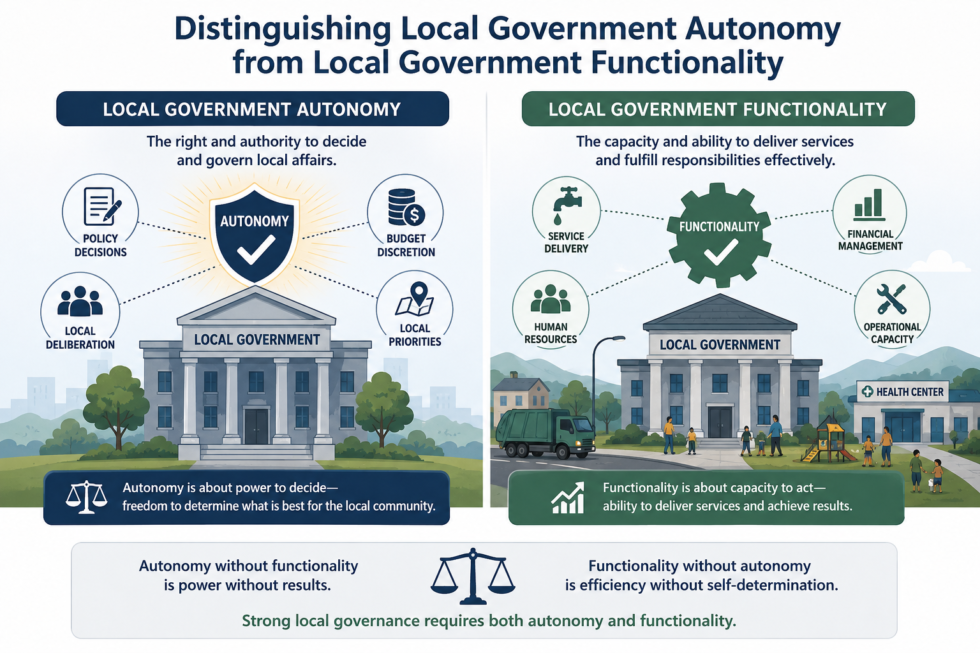
The debate surrounding local government administration in Nigeria has once again taken centre stage, with political actors and commentators often using the terms local government autonomy and local government functionality interchangeably. However, constitutional experts maintain that the two concepts are fundamentally different.
In July 2024, the Supreme Court of Nigeria delivered a landmark judgment directing that local governments should enjoy financial autonomy, including the direct payment of allocations from the Federation Account to democratically elected local government councils. The apex court also ruled that state governments should no longer control funds meant for local governments through the State Joint Local Government Account.
Despite the judgment, implementation has remained slow across many states, with recent reports indicating that several states are yet to fully comply with the Supreme Court’s directives, making the issue a national implementation challenge rather than one peculiar to a single state.
Supporters of Governor Seyi Makinde argue that critics often ignore the distinction between autonomy and functionality.
According to them, while the constitutional demand for financial autonomy remains valid, Oyo State’s local governments have continued to function by paying workers’ salaries, settling pension obligations, carrying out infrastructure projects within available resources, and maintaining essential public services without the widespread salary arrears witnessed in some parts of the country.
They contend that if the objective is to evaluate service delivery at the grassroots, local government performance should also be assessed based on measurable outcomes such as salary payments, project execution, primary education support, healthcare delivery, and other basic responsibilities to residents.
The debate has also extended to comparisons with other states. Some commentators cite Lagos State as an example of a successful local government system. However, analysts note that Lagos enjoys an exceptional revenue advantage, with local governments such as Ikeja benefiting from significantly higher internally generated revenue than many local governments across Nigeria. As a result, direct comparisons with less economically endowed states may not always provide an accurate picture.
Others reference states in Nigeria’s North-East as examples of functioning local governments. However, security experts have repeatedly documented that parts of Borno State, rather than Zamfara, continue to face severe security challenges due to the Boko Haram insurgency, with some local government areas experiencing disruptions to normal governmental activities because of insecurity.
Political observers also point out that local government elections remain under the jurisdiction of State Independent Electoral Commissions (SIECs), not the Independent National Electoral Commission (INEC). Consequently, state governments still exercise considerable influence over the political composition of local councils pending broader constitutional and electoral reforms.
The discussion has equally revived memories of previous cases in which some local government chairmen across Nigeria were investigated by anti-corruption agencies, including the EFCC, over allegations of financial misconduct. Analysts therefore argue that while autonomy is constitutionally desirable, it should be accompanied by strong accountability mechanisms, transparency, and effective financial oversight.
As the national conversation continues, constitutional lawyers insist that the real issue should not merely be assigning political blame but ensuring faithful implementation of the Supreme Court’s judgment across all 36 states while strengthening local government institutions to deliver better governance.
For many observers, the distinction remains clear: local government autonomy refers to constitutional and financial independence, while local government functionality refers to the actual ability of councils to provide services, pay workers, execute projects, and meet the needs of the people. Both are important, but one does not automatically guarantee the other.